WoW Forever Scarce Materials

Herbalism, Mining, and Skinning yield WoW Forever scarce materials as a side benefit while you’re collecting common herbs, ore, and hides. The list is short: nine green items. But the recipes that use them number in the hundreds and cover everything from reagent bags to Invulnerable Mail. A leatherworker faces a double shortage, since even regular hides are in short supply on the auction house. It’s not just the leatherworker who will have to figure out three issues (it’s everyone leveling a profession). Player reports, a snapshot of the auction house from November 10, and the vendor’s prices in Powderfuse Port (which serve as the market ceiling) will help you figure out where to find each material, what to save, and what to sell or process.
What Scarce Materials Are

WoW Forever scarce materials don’t have their own specific locations on the map (no deposits or mobs). They drop as a bonus alongside regular loot. You have a chance to find them when you gather herbs, mine ore, or skin a beast. In World of Warcraft Forever, you can distinguish them from the rest of your bag’s contents by four characteristics:
- The “Scarce” label - check the item tooltip: right above “Crafting Reagent,” you’ll see the white text “Scarce.” Neither Light Hide, Toxic Skullcap, nor any Classic Era item has this label.
- Three tiers - all nine materials are green quality (Uncommon). You can distinguish between the tiers by their item level: 25, 45, or 60.
- Stacks of 20 - one bag slot is enough for 20 items. You can sell any excess on the auction house, since these materials aren’t bound.
- Unknown drop rate - since Blizzard didn’t list the drop rate in either the beta notes or the November 5-9 hotfixes, consider any percentages mentioned in discussions to be player speculation.
Scarce materials are most often used after processing. A tailor can’t do without dye, which an alchemist brews from two rare herbs and an Empty Vial. The blacksmith has two suppliers: the same alchemist with Sulfuric Acid and an engineer with Sandpaper made from Bauxite. But he uses Skinning materials without needing them to be processed by others. Our profession guide will help you choose a couple of professions with these suppliers in mind.
Related Services


All Nine Scarce Materials

The nine Scarce materials in WoW Forever are divided into three equal groups by profession: Herbalism, Mining, and Skinning. Each of them gives one type per tier. You can find out where to use your find in the table below:
| Material | Profession | Item Level | Main Use |
|---|---|---|---|
| Frilled Lichen | Herbalism | 25 | Cerulean Dye |
| Rosecap | Herbalism | 45 | Magenta Dye |
| Stranglevine | Herbalism | 60 | Viridian Dye |
| Pyrite | Mining | 25 | Sulfuric Acid |
| Bauxite | Mining | 45 | Sandpaper |
| Pitchblende | Mining | 60 | Azerothium Bar |
| Pristine Leather | Skinning | 25 | Leatherworking and Blacksmithing |
| Pristine Hide | Skinning | 45 | Leatherworking |
| Pristine Scale | Skinning | 60 | Invulnerable Mail |
The first tier covers gear for levels 10-40. There’s no rush to tackle the third tier until you start working on level 60 gear.
Pristine Leather

In terms of demand, Pristine Leather outpaces all other Scarce materials. This leather requires no processing and can be used in 126 recipes. Of these, 80 are for Leatherworking, 30 for Blacksmithing, and 16 for Tailoring. A separate expense is associated with the Tanning Rack camp station, where a leatherworker crafts 21 items from Pristine Leather. For each piece of gear, you’ll need to set aside a specific amount of leather, whether it’s an item from one of the six leatherworking lines (ranging from Brawler’s to Wisdom’s) or Invulnerable Mail (Leatherworking 295):
| Item | Leather Pieces |
|---|---|
| Belt | 2 |
| Gloves | 2 |
| Boots | 3 |
| Hood | 4 |
| Chestpiece | 6 |
| Pants | 8 |
| Invulnerable Mail | 20 |
During the beta test, Pristine Leather dropped just for characters of levels 1-25 over the entire 20-hour period (and even then, just from level 10-25 beasts). Blizzard did not confirm any such restrictions at the time. The launch added a level 26 character to the list of lucky players. Foxes in Duskwood gave him two pieces after 16 kills. Another player needed 5 minutes of hunting level 16 boars in the Redridge Mountains to collect three pieces. Teldrassil and Darkshore showed the opposite: hundreds of beasts there didn’t give a single piece. I’d keep hunting for Pristine Leather until my character passes level 26. There are no success reports from higher-level characters.
Cerulean Dye and Frilled Lichen

Cerulean Dye is brewed by an alchemist. They get the recipe from the trainer and use two lichens and an Empty Vial as reagents. Tailors need this dye for 108 patterns. Among them are reagent bags. Check with your trainer for the Alchemy requirement for Cerulean Dye: databases list different numbers. You’ll find Frilled Lichen on low-level herbs. Four types have already been reported by players:
- Earthroot
- Mageroyal
- Briarthorn
- Bruiseweed
You can sell the lichen not just to an alchemist. An enchanter also buys it raw, and four pieces are required for Enchant Weapon - Insight (Enchanting 140).
Pyrite and Sulfuric Acid

Pyrite can drop from four types of deposits: Copper Vein, Tin Vein, Silver Vein (except Ooze Covered), and Iron Deposit. Three professions find their own uses for it:
- Alchemy - at skill level 50, alchemists unlock Sulfuric Acid, which requires two pieces of Pyrite and an Empty Vial.
- Blacksmithing - 30 out of 42 recipes that require acid belong to the blacksmith. Without it, you cannot craft gloves of the five lines from Acolyte’s to Veteran’s.
- Tailoring - tailors use the ore raw, as in Shining Boots.
Save every piece of Pyrite: all three professions will need it. Once you move past Iron, it won’t appear again. Transitioning to the next tier of deposits will remove this ore from your route.
Higher Tier Scarce Materials

The second and third tiers are meant for level 45 and 60 items and are otherwise structured like the first tier. You’ll need a higher skill level to process them. Each profession has its own pair of Scarce materials at these tiers:
- Pristine Hide and Pristine Scale - the leatherworker uses Pristine Hide in 43 out of 46 recipes. The Invulnerable Mail recipe, one of 16 items that use it, takes ten pieces of third-tier scale.
- Rosecap and Stranglevine - at Alchemy 130, Rosecap is used to brew Magenta Dye, which is required by 62 recipes. Stranglevine is used by alchemists to make Viridian Dye once their skill reaches Alchemy 230.
- Bauxite and Pitchblende - an engineer at Engineering 130 converts Bauxite into Sandpaper. Blacksmiths get 25 out of 27 recipes that require it. A miner processes Pitchblende themselves: at Mining 275, they smelt it with Coal to produce an Azerothium Bar.
Invulnerable Mail will deplete a skinner’s supplies more than any other item, since it requires both Tier 1 leather and Tier 3 scales.
How to Farm Scarce Materials

You’ll have to plan your farming route based on other players’ observations of zones and veins, since Blizzard has never disclosed the drop rates. This experience boils down to five rules:
- Level and zone - hunt for Tier 1 materials up to and including level 26, since there are no reports of finds from higher-level characters. Regarding the Night Elf starting zones, players have said since launch that they are empty.
- Veins - for Tier 1 ore, head to veins ranging from Copper to Iron, and for Bauxite, head to Gold Veins. Scarce materials are not found in Mithril or higher-tier deposits.
- Skinning in a group - you can skin each corpse once, no matter how many skinners are in the group. Decide before the first pull who is responsible for skinning. Otherwise, one of you will be running in vain to carcasses that have already been skinned.
- Skinning skill - as long as you’re skinning creatures no higher than level 10, one skill point is sufficient. At level 11, the requirement rises to 10 and continues to increase by the same amount for each level up to 20. From level 20 and above, the skill you need is equal to the creature’s level multiplied by five (for level 40, that’s 200).
- Bountiful Harvest - each of the five ranks of this perk yields 20% more Scarce materials. Look for it in the Professions tree of the Legacy system (it unlocks around level 25). A maxed-out perk raises the bonus to +100%, but it doesn’t affect regular loot.
Complaints about the subtle effect of Bountiful Harvest have been around since the beta test. There, a level 15 character with all five ranks found two lichens out of 30 herbs, while another level 30 player didn’t find a single one in 12 hours. I think the difference between them has more to do with their level than with the perk itself.


How to Get Light Hide

Hunters of rare materials have had less luck than those looking for how to get Light Hide: this hide is obtained via the Skinning skill from level 9-25 beasts. It does not have the Scarce tag. Light Hide drops in WoW Forever as it does in Classic, without a single change. It’s still in short supply on the auction house due to recipes that require it after tanning. Along with Light Leather, these hides are given by beasts in four zones:
- Westfall
- The Barrens
- Darkshore
- Loch Modan
Leather drops more often than hide in these zones. One level 26 player reported that out of over a hundred pieces, he found just seven Light Hide. If you’re a leatherworker and need dozens of these hides, skin every animal along your leveling route. It’s more profitable than separate farming.
Cured Light Hide
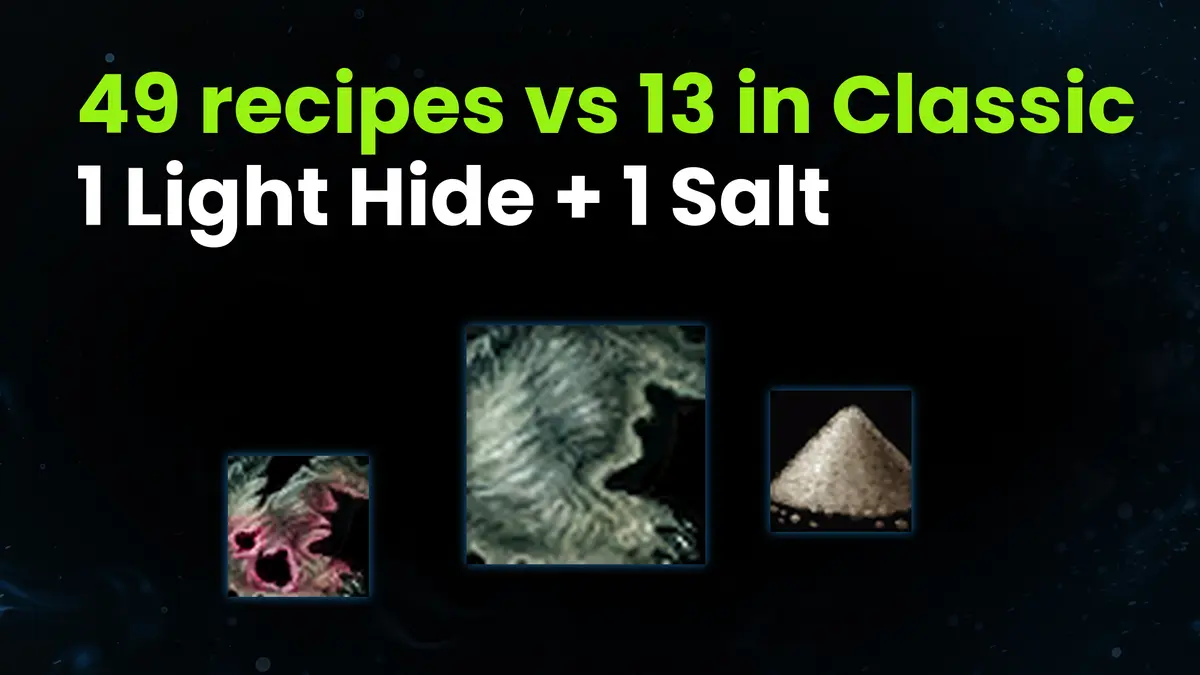
A leatherworker crafts Cured Light Hide using a recipe from the trainer (Leatherworking 35) with one raw hide and one Salt. Three aspects of the tanning process are important for leatherworkers:
- Recipes - in WoW Forever, 49 recipes require tanned hides versus 13 in Classic, including items from the Brawler’s to Wisdom’s lines and the Light Leather Reagent Bag.
- Tanning Rack - no tanning station is needed for tanning. Blizzard lowered the requirement for it from 140 to 125 on November 6.
- Icy Veins route - up to Leatherworking 300, it consumes 27 raw hides and 97 Salt.
A tanned hide on the auction house on November 10 (North America, Normal, Alliance) cost 2s 68c versus 1s 93c for a raw hide. Since the recipe unlocks at skill 35, it’s easier to tan the hides for your own gear yourself. Our breakdown of camp blueprints and workstations explains where to build stations for the rest of a leatherworker’s items.
Materials Worth Holding Onto

Which Scarce materials to hold onto after the launch of WoW Forever is decided by the auction house, since the price of Tier 1 materials has dropped more than tenfold. Tier 1 leather reached up to 2g per piece during the beta test with a level cap of 30. The ceiling is set by the vendor Mister Graphed in Powderfuse Port (Riverglades), who, according to game client data, is selling it for 5g after launch. A goblin ship runs from Steamwheedle Port in Tanaris to Powderfuse Port. Based on an auction snapshot from November 10 (North America, Normal, Alliance), the market was far from this ceiling:
| Material | Price on November 10 |
|---|---|
| Pristine Leather | 7s 97c |
| Pristine Hide | 2s 94c |
| Pristine Scale | 8g 99s |
| Bauxite | 15s 74c |
| Sulfuric Acid | 4s 71c |
| Empty Vial (vendor) | 20c |
At these prices, making Sulfuric Acid from purchased ore results in a loss of 1s 67c, since two pieces of ore at 3s 9c each and a vial for 20c cost 6s 38c versus 4s 71c for the finished item. But the dye yields 3s 57c before the auction house cut, because two lichens at 17s 89c each and a vial cost 35s 98c versus 39s 55c for the finished product. Leather for the entire Stormrider’s line (25 pieces) cost around 2g on November 10 versus 125g from the vendor and around 50g at the peak of the beta. I recommend stocking up on Tier 1 leather for your gear at prices like these and holding onto Pristine Scale, because after launch, players complained about recipes that can’t be made without this leather and listed the scales for 8g 99s with 26 listings across the entire auction house. Our gold guide explains other ways to turn your Scarce material stockpiles into gold.
Skip the Gathering Grind

Recipes require dozens of WoW Forever scarce materials. It’s impossible to predict how many hours it will take to gather them, since the drop rate is still unknown. Instead of farming at random, you can order any of the following three services:
- Profession Materials Kit - for one of eight professions, you’ll receive all materials for 1-150 or 1-300 via mail or trade, along with step-by-step instructions.
- WoW Forever Skinning Boost - our team will skin on your character until your Skinning skill reaches the level you need. You keep all the loot, including items marked as Scarce.
- WoW Forever Mining Boost - we’ll bring your Mining skill up to the desired level without taking any ore or rare materials from the veins your character has mined.
For the sake of leveling the profession itself, I’d go with the Profession Materials Kit, because with it you’ll reach level 150 or 300 without having to buy anything piece by piece. With the Skinning Boost and Mining Boost, the setup is different. Along with the skill, you get everything that dropped along the way. Each of these three services is included in our WoW Forever boosting services, where 99% of customers receive their orders without any account issues.
Scarce Materials FAQ
Can you buy scarce materials from a vendor?
Mister Graphed, a vendor in Powderfuse Port, sells scarce materials in any quantity. His prices don’t fluctuate with the market: during the beta test, he charged 5g for the first tier, 20g for the second, and 50g for the third. Visit the vendor just for items you couldn’t find on the auction house, because those same materials are cheaper there.
Is Light Hide a scarce material?
Light Hide is not considered a scarce material: it’s a common item at item level 10. This hide carried over unchanged from Classic to WoW Forever. It’s in short supply on the auction house due to recipes that use Cured Light Hide, since Blizzard left the drop rate unchanged.
Does Bountiful Harvest affect scarce materials?
Each rank of Bountiful Harvest from the Legacy system increases the loot rate for scarce materials by 20%. You’ll gather the same amount of common herbs, ores, and hides with it as you would without it, because just the items labeled Scarce receive the bonus.
What is Toxic Skullcap in WoW Forever?
Toxic Skullcap is required for the Horde quest “Unending Torment” at level 21. This item is not considered a scarce material. To obtain it, visit Tawny Grisette in Undercity once. She sells it.
Where do you get Cerulean Dye?
An alchemist can brew Cerulean Dye for you using a recipe from a trainer. The dye requires two lichens and an Empty Vial, which costs 20c from a vendor. If you’re a tailor without an alchemist friend, the auction house is your sole option, where on November 10, a ready-made Cerulean Dye cost 39s 55c (North America, Normal, Alliance).